
Good morning! Last week, I was skating through the world of ice wine ⛸️
It was a time that reaffirmed for me how much fun it is to pursue the things that make you wonder, "Why is that?"
Today, I’d like to start by touching upon a question I wrote about in my last article: Since ice wine is made by freezing grapes, can you make something called "ice mead" by freezing honey?
To begin with, does honey freeze?
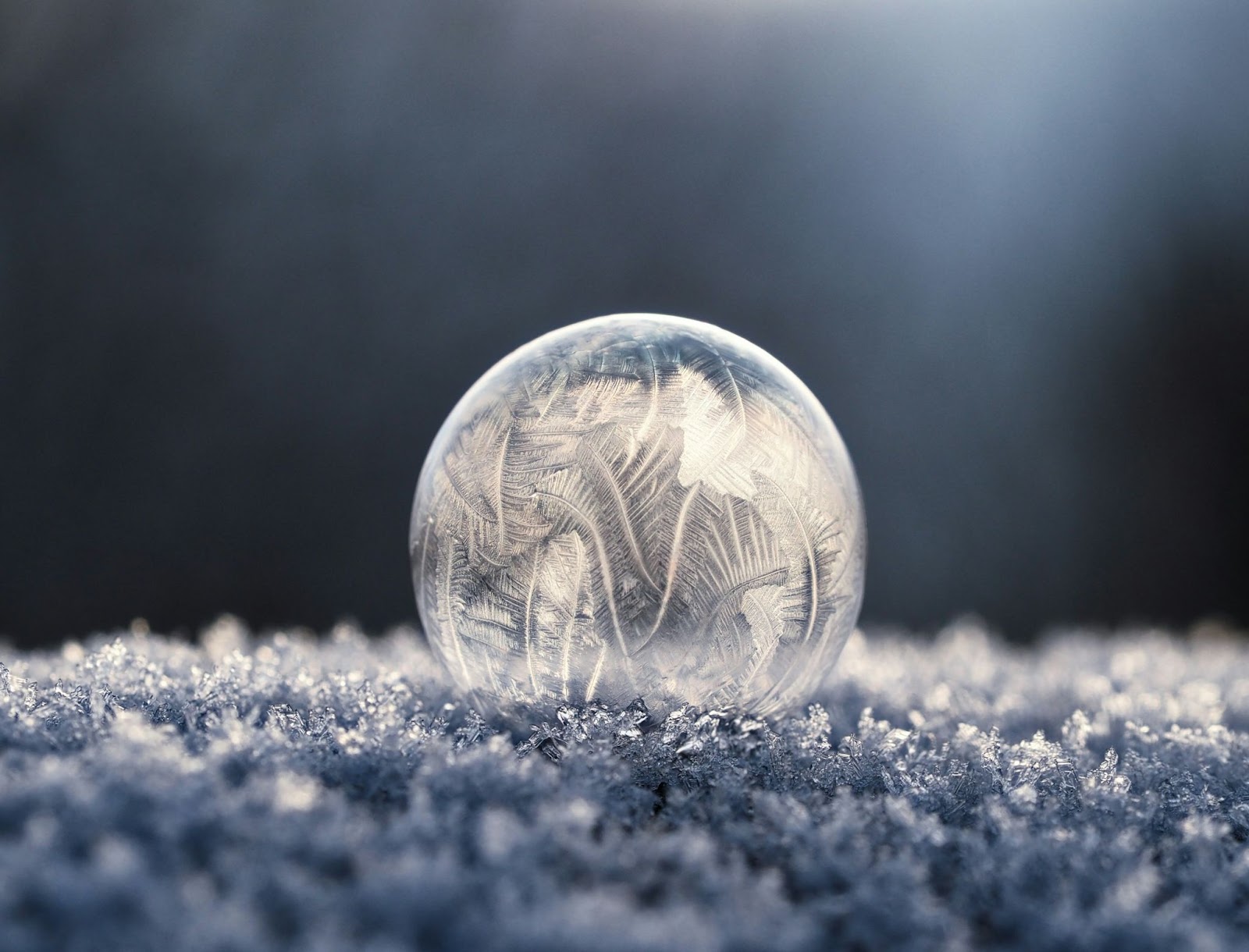
Reflecting on what I learned last time, I noted that: "When grapes are frozen, the water content freezes first, while the sugars remain in the liquid. As the grapes freeze, the water turns into ice crystals, but the sugars, acids, and aromatic compounds do not freeze and remain in the liquid portion."
Honey is about 80% sugar, with the remaining 20% consisting primarily of water, along with trace amounts of enzymes, vitamins, minerals, amino acids, and organic acids.
My hypothesis is that because it contains water, it seems like it would eventually freeze, even if it takes a while. What do you all think?
A while back, around the time I was born, we didn't have the internet. To find the answer to whether honey freezes, you had to go to the library and dig through literature, or conduct an experiment yourself. I suddenly felt anxious, wondering if I would ever experience that excitement—or frustration—of not being able to reach an answer immediately, but today, I’m going to go ahead and reach that answer. 🏃♀️
When I asked Perplexity, the AI I use for research, it told me, "It doesn't freeze in a household freezer (approx. -18°C), but it does freeze in a commercial freezer (-20°C to -30°C)." What does that mean? Before diving into that, let's clarify what "freezing" actually is.
What does it mean to freeze?
"Freezing" refers to the phenomenon where a liquid becomes a solid due to a drop in temperature. It’s when water, which is a liquid, turns into ice, which is a solid, when it hits 0°C or lower. 🧊
Let's dig a little deeper. In the case of water, it goes from a liquid state—where the molecules constituting the water move around freely—to a solid state (ice) as the temperature drops, causing the molecules to slow down and eventually align in an orderly fashion. This is the phenomenon of "freezing."
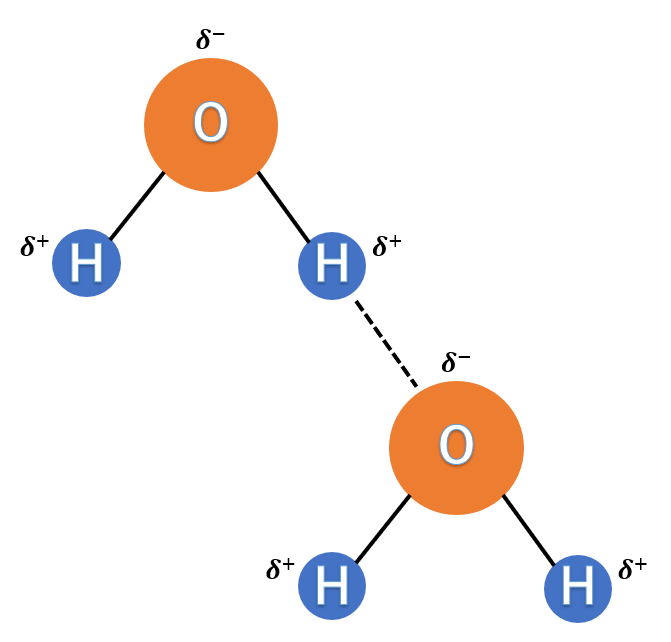
The molecules that make up water are "H₂O," where an oxygen atom (O) is bonded to two hydrogen atoms (H).
A force is created by the partial charges (δ+, δ-) between the hydrogen (positive) of one water molecule and the oxygen (negative) of another. This is called a "hydrogen bond," and the occurrence and stabilization of these bonds are what cause the freezing phenomenon. See the illustration below!
Source: https://rikeilabo.com/hydrogen-bonding
Hydrogen bonds occur even in a liquid state, but at temperatures above 0°C, water molecules are moving actively, so they remain in a constant state of sticking together and separating. This is why water can take any shape. You could compare the water molecules to "people skating on a rink"—they move around freely while occasionally bumping into or moving away from one another.
So, does honey freeze or not?
Back to honey. We’ve established that freezing refers to a state where hydrogen bonds occur between water molecules. However, the main character of this freezing process—"water molecules"—only makes up about 20% of honey.
Molecules other than water, such as sugar molecules (e.g., glucose, C₆H₁₂O₆), get in the way of these hydrogen bonds.
[Water molecule] [Sugar] [Water molecule] [Sugar] ... (random configuration)
In this state, water molecules cannot connect and fix themselves in an orderly fashion through hydrogen bonds, so they cannot reach a state of "freezing." (Water with sugar or salt dissolved in it requires a lower temperature to freeze than pure water; this phenomenon is called "freezing-point depression.")
Specifically, the sugar molecules not only hinder the movement of water molecules and impede the formation of ice crystals, but because there is very little water to begin with, the opportunities for water molecules to bond with each other are limited—a double effect.

The chemical principle explaining this is the "formula for freezing-point depression" (ΔT = K_f × m).
Here, ΔT represents the extent of the decrease in freezing temperature, K_f is the substance-specific constant (1.86 for water), and m is the concentration of the solute. In the case of honey, because the sugar concentration is extremely high (m is large), ΔT becomes large, causing the freezing temperature to drop significantly.
In fact, it doesn't freeze at the temperature of a household freezer (approx. -18°C); it only becomes more viscous. The increase in viscosity is due to the overall slowing of molecular motion at low temperatures and the partial freezing of a small amount of water, which reduces the overall fluidity of the honey.
In the commercial freezers (-20°C to -30°C) I mentioned earlier, only the water content partially freezes. The sugars become a glass-like solid (amorphous) rather than forming complete ice crystals. It seems that nearly -40°C is required for the entire honey to freeze uniformly. At this temperature, rather than crystallizing, it could be described as solidifying into a glassy state. (It seems that in polar or high-latitude regions like the Arctic, Antarctica, Siberia, and Northern Canada, temperatures can drop below -40°C in winter.)
In conclusion, honey does freeze in the sense that the water inside it freezes, but the conditions are strict, and it is practically "not frozen" in an everyday environment.
So, if we were to place honey in an environment below -40°C and it froze, could we make mead?
Does Ice Mead Exist?
The appeal of ice wine, after all, is that the grape sugar content is about double the normal level before fermentation. In the process of making mead, because of the high sugar concentration, you have to mix honey with water to lower the sugar level before fermenting it.
Even if you used honey where the water had been removed to leave only the sugar, you would just end up adding more water to mix it, so my hypothesis is that "ice mead" cannot exist.
Well, what is the reality?
Upon researching, it seems the category of "ice mead" does not exist. However, there does seem to be mead that is sweeter and has a higher alcohol content, similar to ice wine. Its name is "Jadwiga."
Jadwiga is named after the Polish Queen Jadwiga of Anjou and is said to be a traditional luxury mead that was once served only to royalty and nobility.
While normal mead uses a ratio of 1 part honey to 2–3 parts water, "Jadwiga" uses a staggering 3 parts honey to 2 parts water! It apparently used to have an aging period of about 8–10 years. Thanks to technological advances, that’s been shortened to about 6 years, but that’s still 6 years. It is a very sweet mead with an alcohol content of 16–18% and a sugar content of over 40%! Okada-kun was surprised that it’s a liquid even sweeter than the "must" (the state before mead is made).
Since typical soft drinks are around 10% and even concentrated vegetable juices are around 20%, 40% isn't really a beverage anymore—it’s more like condensed milk or syrup.
It’s about 7,000 yen for 750ml. Maybe I’ll buy some for Okada-kun’s birthday present.
シェアする:
Dear Sommelier - Why do frozen grapes make for such an intensely sweet wine? Exploring Canadian Icewine